Written by Farmers, for Chickens: How “Kai Suk Jai” Standard is Reshaping Thai Poultry Farming
บล็อก
Most people who care about what they eat have started asking questions about where their food comes from. But there is a question that rarely gets asked: what kind of life did the animal live? A group of farmers in Nakhon Ratchasima and Surin provinces is making sure that the question has a real answer.
Working under the Healthy Chicken Thailand project run by Patom Organic Living (Patom for short), a grantee of the Investing in Others programme, is answering that question by building a system of their own. What they are building is called a Participatory Guarantee System, or PGS: a standard that farmers write together, verify amongst themselves, and learn from as they go. They have named it "Kai Suk Jai."
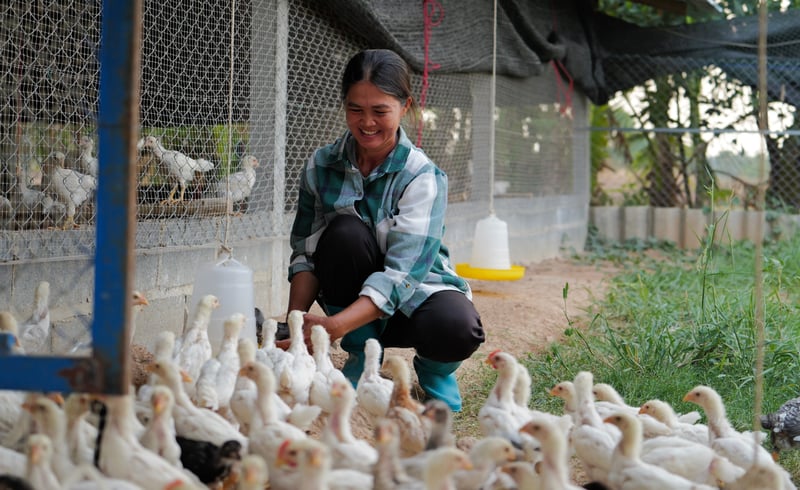
 Surin chicken farmers who work with Patom Organic Living
What is a PGS?
Before understanding what Kai Suk Jai is, it helps to know what PGS actually means.
A PGS is a standard assurance system in which members of a group verify and certify one another directly, rather than relying on an external organisation to issue a certificate. Third-party certification is often costly and may not reflect the reality of small-scale farmers on the ground. The concept has been widely used in organic farming circles worldwide for several decades. IFOAM Organics International defines a PGS as a system built on the foundations of trust, participation, and knowledge-sharing within a community.
What sets a PGS apart from external certification, in Patom's view, is its flexibility. Standards are designed specifically for the group and can be adapted to suit the context, geography, and real needs of its members. Crucially, it is a shared learning process, not just a document left gathering dust on a shelf.
Why Kai Suk Jai?
The Kai Suk Jai PGS did not come about from a writing session in a meeting room. It emerged from Patom's team and the project's farmers blending knowledge from three distinct sources into something new.

The first was a structure with a proven track record. Patom drew on the PGS developed through the Sampran Model, a network under the Sangkom Sukjai (Happy Society Foundation) with which the team had worked closely for nearly 15 years. The backbone of this system was not invented from scratch; it had been tested in real conditions over a long period.
The second came from the direct, hands-on experience of someone who had been farming for over a decade. Varakorn Laohasereekul, an adviser to the project and a member of the Rom Yen Ratchaburi organic farming group, brought the animal welfare PGS already in use across his own network into the mix. This meant the resulting system was not drawn purely from theory but was grounded in what had actually worked on the farm.
The third was an internationally recognised animal welfare standard. The team incorporated the high-welfare guidelines from World Animal Protection to ensure that the heart of this PGS was genuinely the well-being of the chickens.
The case for having a shared framework is straightforward. Without one, each farmer would interpret animal welfare differently: some drawing on their existing knowledge, others guessing at what their peers expected. The group would end up pulling in different directions. The PGS serves as a shared track for everyone to walk together. When someone drifts from it, the other members can help bring them back.
The name the group selected during the meeting conveys more than any description ever could. "Kai Suk Jai" does not simply mean happy chickens. It refers to a peace of mind that flows from one end of the supply chain to the other: chickens living in an environment where they can express natural behaviour fully, farmers who raise them knowing that if the product falls short of the standard, there are ways to correct and improve rather than simply being judged as a pass or a fail, and consumers who eat with a clear understanding of where their food comes from.
What does the PGS measure? What do chicken actually need?
If there is one direct answer to what the Kai Suk Jai PGS measures, it is the well-being of the chickens themselves.
Varakorn explains it simply: the best way to know whether a chicken is doing well is to observe its behaviour. Does chicken run towards people or away from them? Where does chicken sleep? Where does chicken scratch and forage? What a chicken does tells you more than any indicator on paper. Sometimes the things designed for chickens to use, such as a particular bedding material, are ignored in favour of somewhere else entirely. That, too, is valuable information. The PGS is not concerned with forcing everything to fit a written standard; it is concerned with what genuinely works for the birds.

The name Kai Suk Jai makes it clear that we focus on the life of the chicken. We go back inside the chicken's heart and mind and look outward to see what they want. Then we design the whole environment around that: the people, the food, everything that lets them live the way they are happy to live.
Another central pillar is the Korat chicken, a semi-native breed developed and raised in Thailand. It is naturally suited to the local climate, vegetation, and environment without requiring medication or artificial conditions. Choosing this breed is not simply a matter of taste or price; it is a design decision that aligns the system with the animal's nature from the beginning.
 Korat chicken breed
Because this PGS prioritises real-world observation over rigid rules, many of its specific figures emerged from debate and shared learning. The question of how many birds per square metre to keep indoors, or how much outdoor space to provide, was one such case. The team initially cited an international standard requiring 4 square metres of outdoor space per bird. But observing actual behaviour revealed that chickens tend to cluster and move together rather than spread out. The group therefore adjusted to an outdoor space roughly twice the size of the sleeping area, which better matched how the birds naturally behaved.
What life look liks under Kai Suk Jai
These are not abstract commitments. They translate into specific, verifiable practices that farmers apply every day and that consumers can ask about. Here are a few examples drawn from the standards the farmers wrote together.
Chickens must be able to express natural behaviour. Farms are required to provide enrichment such as sand baths, perches, and hay bales so that birds can peck, scratch, and nest. These behaviours are instinctively driven to perform. Without an outlet for these instincts, chickens are likely to begin pecking at one another within the flock.
Stocking density is designed around the chicken, not around the space. Under this PGS, farms may keep no more than ten birds per square metre in the sleeping area, with an outdoor run at least twice that size. These figures are carefully planned to allow chickens space to move, forage, and live together peacefully.
Antibiotics are permitted, but transparency is non-negotiable. The standard does not ban the use of antibiotics entirely. If a sick bird requires treatment, the farmer must record the type of medication, the date it was given, and the withdrawal period clearly. Any bird that has received antibiotics twice is permanently removed from the flock register. This reflects a straightforward principle: honesty within the group matters more than production numbers.
 Isolation area for sick chickens
Light and darkness both carry meaning. The standard specifies that chickens must receive at least eight hours of continuous light and six to eight hours of complete darkness each day. This natural light cycle directly affects the birds' physical and mental health. It is not just a question of lighting in the shed.
These standards are not fixed. The group of farmers can revisit and revise them each month as new lessons emerge from the farm itself.
Flexibity is strenght, but standard holds
One of the defining features of the Kai Suk Jai PGS is that it was never designed to work the same way for everyone.
Most government standards are drafted from academic literature and international benchmarks. They cover all contexts, but they are often too broad for small-scale farmers to apply meaningfully in daily practice. Some provisions rarely arise on a small farm; others create burdens rather than benefits. The Kai Suk Jai PGS strips out what is unnecessary and keeps only what has been shown to work.
This flexibility is clear at several levels. Farms in forested areas and those on open land use the same PGS but apply it differently according to their surroundings. A farmer selling live birds operates differently from one who processes or retails, yet all are guided by the same core principles.
The PGS also does not stand still. The group meets monthly to share progress, raise questions, and revise the content as needed. When most members agree that something is not working or that a better approach exists, adjustments can be made immediately, without waiting for approval from any external body.
This flexibility, however, does not mean that everything is permitted. That is precisely where an adviser such as Varakorn plays a role: not as someone with authority to direct, but as a point of reference that helps the group stay true to the path it agreed to walk together.
 Varakorn, Consultant for the Healthy Chicken Thailand project
Some consumers may have a question: if things can be adjusted at any time, where does the standard actually sit?
The key is to identify what is flexible and what is fixed. What is adjustable is the environment and the management approach that best suits each farm's context. If weather conditions in each week raise the risk of disease spreading, temporarily keeping the chickens inside may be the better choice: not for convenience, but because it serves the birds' interests. What is never adjusted are the core principles: food safety for the consumer, the transparent and minimal use of medication, and the consistent observation of chicken behaviour to ensure they are free from discomfort. These principles align with the Five Domains of Animal Welfare, an internationally recognised framework, and they represent a line that everyone in the group has agreed not to cross.
Try to imagine this: given the choice, would you rather live in a home designed around your life, or one that is identical to everyone else's? Kai Suk Jai chooses the former. However the home looks, the structures that keep it safe and liveable are never removed.
Kai Suk Jai across the whole supply chain
The PGS approach that Patom has adopted opens the door to everyone in the food system: government agencies, universities, private businesses, and consumers. No one needs to raise chickens or grow vegetables to participate. What matters is the willingness to contribute, share perspectives, and support the system in whatever capacity suits them.
What changes in this model is the position of the consumer. Traditionally, consumers sit at the far end of the supply chain as recipients. The Kai Suk Jai PGS creates space for them to take part in shaping the food system they want to see: by saying what kind of chicken they prefer, by asking for children to have opportunities to learn on farms, or by calling for changes in how animals are raised. This is what it looks like when consumers begin to play a role in defining the food system they are part of, rather than simply waiting as a recipient.
The ambition extends well beyond selling chicken at a better price. A stronger upstream means farmers with stable incomes and genuine pride in what they raise. A more transparent midstream means traceability that consumers can actually verify. A downstream that is genuinely involved means a market that grows through trust, not through the lowest price.
Sustaining it is the real challenge
Despite the clarity of its intentions, the team knows that building the Kai Suk Jai PGS is only half the work. Keeping it alive - sustaining the spirit of collaboration, the willingness to be observed by peers, and the discipline to hold the line on core principles is the harder and more important task.
"Everything tends to deteriorate over time. What we have to protect is not the document, but the integrity of every person in the group." - Varakorn Laohasereekul
A further challenge lies downstream. Most consumers are not yet familiar with a PGS and may not be able to see how it differs from a standard label on a package. Building that understanding and trust takes time; it cannot be achieved simply by attaching a logo to the packaging.
For Patom, the personal challenge is maintaining the balance between offering guidance and overstepping. The PGS belongs to the farmers, not to Patom. Its most fitting role is to hold the perspective of the consumer and the trading partner, rather than to set the direction.
This kind of honesty is itself a sign of a system built to last. The Kai Suk Jai PGS is not a certification label or a marketing claim. It is a living commitment, made by a group of farmers who decided that the chickens in their care deserved better and that consumers deserved to know it.

Through the Investing in Others programme, World Animal Protection is proud to support Patom Organic Living and the farmers behind Kai Suk Jai as they demonstrate what is possible when animal welfare is placed at the centre of the food system, not as a regulation imposed from above, but as a shared value built from the ground up.