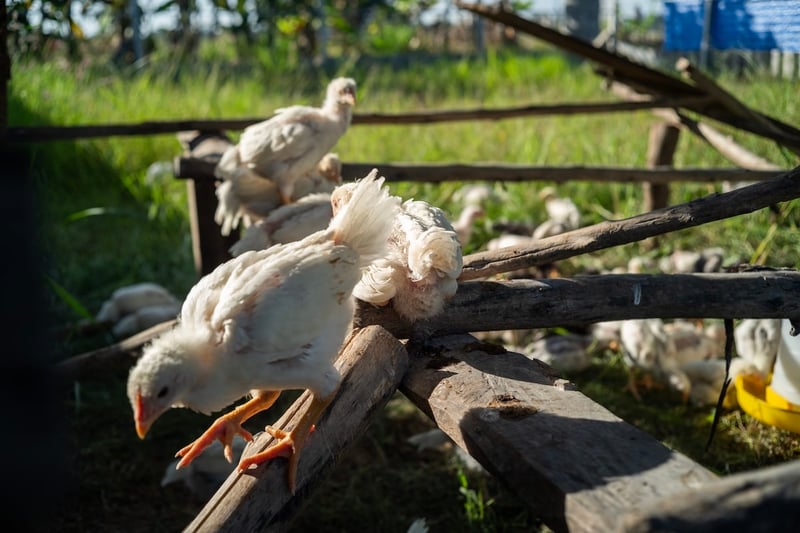
Globally, there is increasing attention to livestock systems that are humane, sustainable, and fair to farmers. Thailand is part of this broader movement, with more producers adopting high-welfare practice that promotes better lives of animal and safe food.
Patom Organic Living’s “Healthier Chicken Thailand” initiative supports these aims by assisting farms that wish to adopt higher standard while remaining support holistic community-based model.
Last November, the Investing in Others team visited eight farms in Nakhon Ratchasima and Surin Province to observe how these efforts are taking shape on the ground.
Across all sites, we saw promising progress as farmers transitioned their systems toward higher welfare practices in their everyday operations. The changes may look simple, but they have a significant impact on chicken well-being and farmer confidence. Some of the practices observed include:
- Farmers typically receive 100–200 chickens per batch, giving each bird more space to move naturally; this helps reduce physically and mentally impacts to animals
- Farms have open-sided structures and large open areas where chickens can explore, dust-bathe and express natural behaviours.
- Basic enrichment, including perches, shaded areas and natural materials, is provided to keep birds active and reduce stress.
A few moments from the field stood out:
When we spoke with Khrueawan Sangsaowaphak at Khrueawan Farm , she explained that before increasing space, chickens were kept indoors in a confined area and had no access to outdoor space.

“In the past, the chickens stayed indoors all the time indoors,” Khrueawan said. “When the weather was hot, they became stressed very easily. As they grew bigger, there was less room to move. Sometimes they chased each other, pecked, or flapped their wings a lot because of the heat.”
These signs were easy to notice. The chickens were tense, and the people caring for them felt the stress as well.
“When the chickens were stressed, we were stressed too,” Khrueawan added. After adjusting the system, there is more space as outdoor area was expanded, providing the chickens significantly more room to move freely.
The difference, she said, was clear.
“What changed the most was their mood. The chickens became more relaxed and active,” Khrueawan explained.

“They could walk, scratch the ground, move around and use the space outside. It feels like they are exercising more and enjoying their environment.” She described how behaviour shifted once the chickens had access to open space and perches.
This calmer behaviour also changed daily farm work. “It makes everything easier.When chickens are not stressed, the farmers also feel calmer. It is both the chickens and the farmers’ benefit.” Khrueawan added.
When asked how she would explain the importance of space to other farmers, her answer was simple.

If we raise chickens, the first thing is freedom. I don’t want them to feel confined like before. When chickens are stressed and peck at each other, we feel uncomfortable too. But when you see chickens walking calmly and moving freely, you feel better as well. Happier chickens mean a better environment for everyone, including the people raising them.
At Pluto Farm , Thawatchai Phuangchan explained that before adopting high-welfare practices, the main challenge was environmental impact, particularly odour.

At the time, around 1,000 chickens were kept in a closed housing system. Odour problems were not limited to the rainy season. They also occurred during summer, when chickens played in water to cool down, leaving the floor wet. When moisture mixed with manure and urine, ammonia builds up quickly.
“The smell travelled with the windwithin a distance of about 200 to 300 metres, neighbours would start telling us that it had reached their homes,” Thawatchai added.
After changing to a high-welfare system, the situation improved significantly. Chickens no longer stayed inside all day. With lower stocking density and access to outdoor areas, heat and moisture stopped accumulating inside the house. The litter remained dry, ammonia did not build up, and the smell almost disappeared.
Pluto Farm also raises chickens without routine use of antibiotics. Instead of relying on medication, the farmer focuses on prevention through cleanliness, space and observation. The individual sick animals will be treated separately and the root cause of illness will be resolved without preventative use of drug across the herd.

Beyond animal welfare and environmental improvements, the farmer highlighted the farm’s social impact. He has invited local teenagers to work there, providing them with income, eggs, and practical learning opportunities. Through daily routines, they learn how a welfare-focused farming system works. More importantly, they see that chicken farming does not have to depend on industrial confinement or heavy drug use.
“I understand that raising chickens is not just about feeding and selling, it’s about practices, living conditions and responsibility,” Thawatchai said.

In the future, Thawatchai believes that higher-welfare chicken farming can reduce on factory-farmed meat. Consumers become more concerned about food safety and transparency; they want to know where their food comes from and how it’s produced. Therefore, transparency and welfare-focused systems are better positioned to meet that demand and support a transition toward a more responsible food system.
This is a strong, evidence-based example of positive progress towards an equitable, humane and sustainable food system (EHS) that World Animal Protection is working to achieve. This model is not only implemented in Thailand; through the Investing in Others Project, we are also supporting partners across the Southeast Asia region to drive this shift.
Patom Organic Living is also moving further by introducing high animal welfare standards as part of the Participatory Guarantee System (PGS) within their farmer network. PGS is a community-based certification system for organic farming, built on active participation, mutual trust and shared responsibility among farmers and other local stakeholders. Rather than relying on external certification bodies, farmers within the network regularly meet, visit each other’s farms and exchange knowledge, allowing them to learn together and continuously improve their practices. This approach helps small-scale farmers strengthen their farms, build community accountability and gain better access to local markets.
Adding animal welfare criteria to the PGS framework is an ambitious step, and Patom aims to scale this initiative across the whole province over time. During the field visit, we also had a brief discussion with representatives from the Department of Livestock Development in Surin, and we hope they will support this idea and consider adopting or endorsing this practice at the provincial level.

The visit showed again why high-welfare and Patom’s model works. By working with existing farms, strengthening the supply chain, and linking farmers to real demand for high-welfare chicken, the project supports animal welfare, consumer health, and farmer livelihoods.
Looking ahead, Patom aims to expand this model by growing its farm network, increasing supply for both B2C (Business-to-customer) and B2B (Business-to-business) markets, and integrating high-welfare standards into systems such as PGS. This approach has the potential to influence wider food system change in Thailand and, as part of the Investing in Others programme, offer practical learning that can inform and inspire similar efforts across Southeast Asia.
Learn more about FANSEA: https://www.worldanimalprotection.or.th/our-work/farmed-animal-network-southeast-asia/